Sherman On Software Latest

  • How Running Off A Messaging Queue Impacts Data Loading Strategies

    How Running Off A Messaging Queue Impacts Data Loading Strategies

    Messaging systems don’t change the fundamental tradeoffs involved in data loading, but they do add a lot of opinionated weight to the choices. 

    First, messaging and streaming have a lot of potential meanings and implementations.  To overgeneralize, there are queues, where each message should be read once, topics, where each client should receive each message, and broadcast, where there are no guarantees about anything.

    Queues and topics work as polling loops within your software.  Broadcast messaging comes directly to the machine at the network level; the abstractions are highly dependent on implementation.

    For the rest of this article I’m going to cover queues.  I’ll cover topics and broadcast in future articles.

    Loading Patterns with Queues

    The main feature of a message queue is that you want each message to be processed exactly once.  This requires clients claim messages when taking them off the queue, notifications back to the queue when messages have been processed, and a client timeout, after which a claimed message will reappear at the head of the queue.

    A client has to connect to a queue, ask for some number of messages and indicate how long it will wait for the max number.  For example, AWS’ SQS the defaults are 10 messages or 30 seconds.  The client will block until 10 messages are available, or it has been waiting for 30 seconds.

    Set the message request too big and you will wait while the queue fills.  Set the timeout to long and the first few messages will get stale while the client waits.  You need to balance the time cost of polling the queue against the cost of having your workers idle.

    The main concern however, is visibility timeouts.  If your client grabs 10 messages and has a 30 second timeout it absolutely must finish all 10 in under 30 seconds.  After 30 seconds the unacked messages will be released to the next waiting worker and your message will be processed twice.

    Optimizing worker counts, polling settings, and timeouts requires maximizing execution consistency.  When working at scale, how long an action takes matters much less than how consistent the timing is.

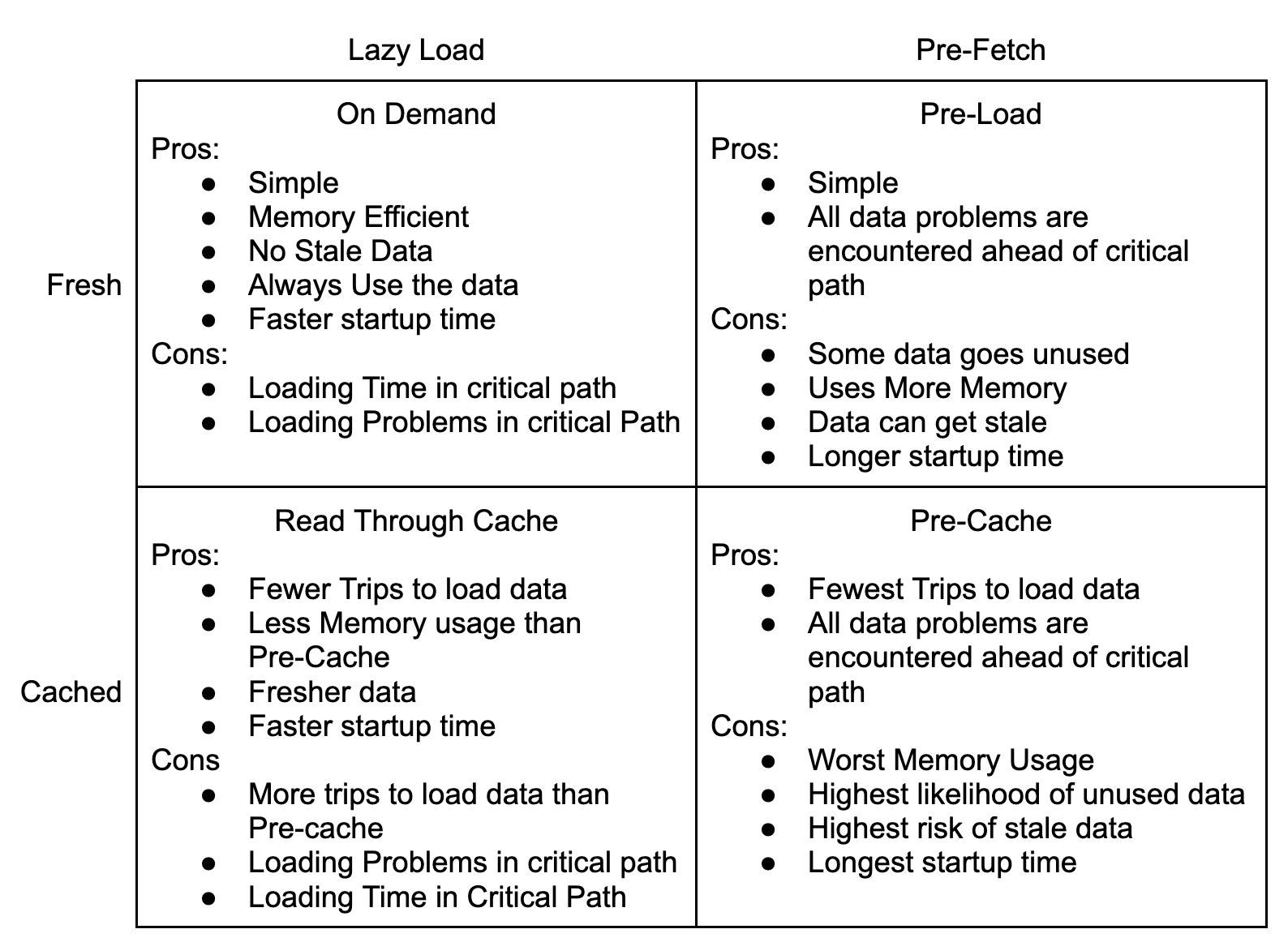
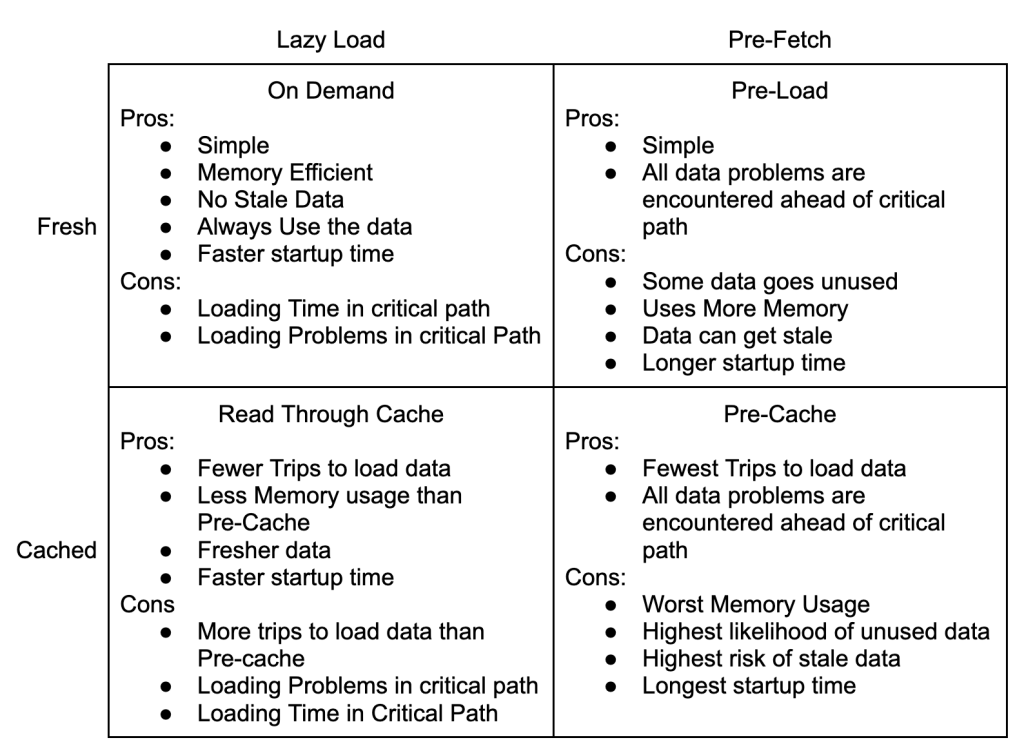
    The Four Patterns of Data Loading are all about tradeoffs.
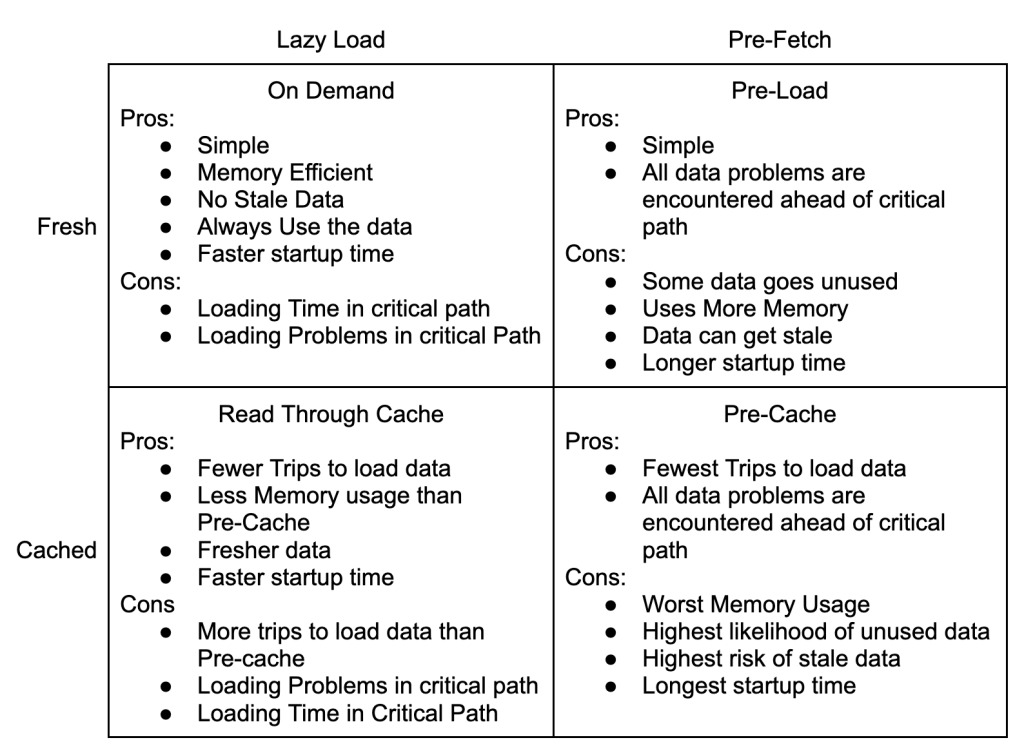
    If your system is drinking from a firehose, you need to push everything towards a Pre-Cache model.  Pre-Cache pushes data loading out of the critical path, which gives the most consistent timing for message processing.

    Having fully Pre-Cached queue processors is rarely possible, there is too much data and it changes to often.  Read Through Caching is the practical alternative.

    Link Tracking Example

    Link Tracking, recording when someone clicks on a link, is a common activity for Marketing SaaS.  I’m going to use a simplified version and walk through each of the data patterns.

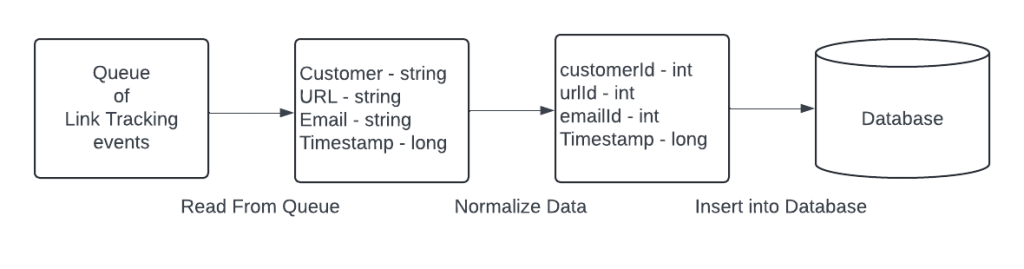
    At a high level, we have a queue of events with 4 pieces of data that describe the click event: Customer Name, URL, Email, and Timestamp.  

    We want to process each event exactly once, as quickly as possible, and we don’t care about the order messages are processed.  However, we can’t insert directly, we need to normalize Customer Name, URL, and Email into customerId, urlId, and emailId.
    Lazy Load

    The nice things about the Lazy Load pattern is that it starts quickly and is simple to understand.

    Unfortunately, every event requires 3 trips to the database to normalize the data.  This adds load to the database and has highly variable processing time.

    It’s a fine place to start, but a terrible place to stay.

    Pre-Fetch

    The Pre-Fetch pattern separates fetching the data into a separate step from execution.  In this example, the worker would be attempting to normalize multiple events at the same time.  Once an event has been fully normalized, it is inserted into the database.

    Pre-Fetch adds a lot of complexity because the workers now have internal concurrency in addition working in parallel with each other.  This might be worth it if the data was being composed from different resources in a micro-service architecture and the three calls could be done in parallel.  In this example though, you would be pounding the database.

    Pre-Cache

    The great thing about a Pre-Cache model is that there are no reads against the database during processing.  It is read-only during init, and write only from the queue.  That will really help the database scale!

    Pre-Cache is impractical in this use case though.  We might know the full set of customers at startup, but urls and emails are open ended.  Pure Pre-Cache setups require that all of the data be known before starting.  That can work for things like file imports and trading systems,  but not link tracking.

    Read Through Cache

    The Read Through Cache Pattern is likely to be the best option for our use case.  It is more flexible than the Pre-Cache Pattern and much friendlier to the database than Lazy Loading or Pre-Fetching.  It pushes complexity to the cache where there are lots of great solutions.  Most languages have internal caching mechanics, and external caches like memcached and redis are widely supported.

    Conclusion

    Reading from message queues is a common problem and usually requires composing data from a database.  What’s the best way to load the data?  As always, the right data loading pattern depends on a your conditions and assumptions.  

    Lazy Loading is always a decent place to start because it is simple.  Performance, cost, and scaling constraints will push your design towards Read Through Caching and Pre-Caching.  Pre-Fetch models are likely to be more effort than they are worth because they add a second source of concurrency and complexity.

    Remember, requirements change over time, so will the best solution to your problem!

  • The Never Rewrite Podcast, Episode Fifty-Five, Writing Your Job Out Of Existence

    The Never Rewrite Podcast, Episode Fifty-Five, Writing Your Job Out Of Existence

    Isaac and Jeffrey discuss the mindset of writing your job out of existence. They explore the idea that being irreplaceable can be a trap and that making your current role disappear in a positive way is the key to career growth. They share examples of individuals who get stuck in repetitive tasks and fail to see the opportunity to transform their work. The conversation highlights the importance of reframing problems as opportunities for improvement and the need to overcome the fear of change. They also touch on the issue of intentionally not fixing problems to protect one’s job.

    Watch on YouTube or listen to it at NeverRewrite, Spotify, Apple Podcasts, or Amazon Music, and let us know if you have ever been involved in a rewrite. We would love to have you on the show to discuss your experience!

  • For Better Iteration, Imagine Heaps, Not Queues

    For Better Iteration, Imagine Heaps, Not Queues

    A new project arrives, you gather the team, and start planning.  You talk through the requirements, write up the work, and put it in order.  Then you iterate!  Repeatedly work on the first task in the queue and keep going until the queue is empty.

    Iterating off of a queue sounds iterative, it’s right there in the description.  But it misses the mark because it ignores everything learned from implementing each piece of work.

    Instead of imagining a work queue, envision a heap. With a heap, you are only guaranteed that the top element is most important.  That’s it, the top, and the rest.  Critically, when you take the top piece of work, you have to sort the heap.  A heap forces you to consider what you’ve learned and apply it to determine what comes next.

    An iterative process requires constant re-evaluation.  There’s the current most important step, and a heap of work.  Iterating off a perfect work queue is a sirin song, an illusion and a trap.  To iterate, learn, and apply your learning, after every step.

  • The Never Rewrite Podcast, Episode Fifty-Four, Shadow Your Colleagues

    The Never Rewrite Podcast, Episode Fifty-Four, Shadow Your Colleagues

    Jeffrey and Isaac discuss how to get started with shadowing people and solving their problems. They share their experiences and strategies for shadowing, including reaching out to the people you want to shadow, observing their tasks, and identifying areas for improvement. They emphasize the importance of shadowing during the onboarding process and the value of asking questions and challenging existing processes. They also highlight the benefits of building relationships and earning credibility by solving problems for others.

    Takeaways

    • Shadowing people and solving their problems is a great way to learn and make a positive impact in a new role.
    • During the onboarding process, take the opportunity to shadow and observe how people work.
    • Ask questions and challenge existing processes to identify areas for improvement.
    • Building relationships and earning credibility by solving problems for others is crucial in the workplace.

    Watch on YouTube or listen to it at NeverRewrite, Spotify, Apple Podcasts, or Amazon Music, and let us know if you have ever been involved in a rewrite. We would love to have you on the show to discuss your experience!

  • The Never Rewrite Podcast, Episode Fifty-Three, Cloud Infrastructure “Rewrites”

    The Never Rewrite Podcast, Episode Fifty-Three, Cloud Infrastructure “Rewrites”

    Isaac and Jeffrey discuss the topic of doing full rewrites when it comes to architecture. They explore a case where a client needed to move from a single EC2 instance to a more stable system with load-balanced instances. They discuss the parallels between rewriting code and rewriting architecture, and the challenges and risks involved.

    Watch on YouTube or listen to it at NeverRewrite, Spotify, Apple Podcasts, or Amazon Music, and let us know if you have ever been involved in a rewrite. We would love to have you on the show to discuss your experience!

  • Tradeoffs with the Four Patterns Of Data Loading

    Tradeoffs with the Four Patterns Of Data Loading

    The Four Patterns Of Data Loading are about two main trade offs: simplicity for performance, and freshness for execution consistency.

    This may seem odd because the quadrants are defined by loading and caching strategies, not simplicity, performance or execution consistency.

    Simple or Performant

    The decision to use caching is about trading simplicity for performance.  You can simply load the data every time you need it.  If you’re using MySql on AWS, a basic query will take about 2ms to return.  The pattern is very simple and self contained: load data when needed.

    Caching, saving data for reuse, improves performance by reducing the time it takes to use the data again.  In exchange, you have to think about your code and determine:

    • Will I use the data again?
    • Is the data likely to change in the DB while I have it cached?
    • If the data does change, do I want to use the latest version or the version that the process has been using so far?
    • How much server memory will I need for the cache?

    Example – Adding a Tag to a Contact

    Imagine a simple operation, adding a tag to a contact.  The tag is a string and the contact is represented by an email address.  You need to transform the tag and email into ids and store them in a normalized database table.  For simplicity’s sake, let’s say all DB operations take 2ms.

    There are 3 DB Operations

    1. Load the contactId based on email
    2. Load the tagId based on tag
    3. Insert into contact_tags

    With the On Demand access pattern, we do each action every time.  This requires 3 trips to the DB for 6ms.

    Similarly, with the Pre-Load pattern, we spend 2ms pre-loading the tagId, and each operation takes 4ms.

    Using a Read Through Cache, we store the tagId after the first load.  The first operation takes 6ms and each additional operation takes 4ms.

    Finally, with the Pre-Cache pattern, we spend 2ms pre-loading the data and each operation takes 4ms.

    1 Tag, 1 Contact1 Tag, 10 Contacts10 Tags, 10 Contacts
    InitExecInitExecInitExec
    On Demand0ms 6ms0ms60ms0ms600ms
    Pre-Load2ms4ms20ms40ms200ms400ms
    Read Through Cache0ms6ms0ms42ms0ms420ms
    Pre-Cache2ms4ms2ms40ms20ms400ms

    Freshness or Execution Consistency

    The next tradeoff to consider the value of fresh data vs execution time consistency.  This goes beyond questions of caching, it also affects whether you can use the Pre-Load strategy at all.  A big advantage of the Pre-Load and Pre-Cache strategies is that the execution time is lower and less variable.

    Stock trading software is designed to pre-load as much data as possible and can spend minutes initializing so that the actual buying and selling happens in microseconds.  Similarly, internet ad networks like Google’s demand responses in 100ms or less.  Having consistent execution times in each piece of your software makes it much easier to monitor performance for signs of trouble.

    Security software and reporting sit on the other end of the spectrum.  It doesn’t matter if a user had permission 5 minutes ago and everyone hates waiting for report data to update.  In these cases the variance for each response is much less important than getting the most recent data.

    Some data never changes once it has been created.  In the example above of adding a tag to a contact, both tagId and contactId will never change during your program’s execution.  Generally, anything with ‘id’ in the name is safe to cache.  On the other hand counts, permissions, and timestamps change all the time.

    Strategies can be good for some situations and terrible for others.  Sometimes it depends on expectations vs money.

    Ids and static dataPermissionsCounts and Reporting
    On DemandBadGoodGood, until it doesn’t scale
    Pre-LoadGoodIt depends on time elapsedIt depends on time and money
    Read Through CacheGoodIt depends on time elapsedIt depends on time and money
    Pre-CacheBestBadIt depends on time and money

    Conclusion

    The “right” data loading pattern is a moving target.  Remember that in the beginning load is low and there are continuous changes.  Simplicity is always a great choice when there isn’t enough scale to justify complexity.

    As software matures two trade offs emerge: Simplicity vs Complexity and Freshness vs Consistency.

    You’re changing the software for a reason.  When you consider the tradeoffs it should become clear which patterns will help solve your problem.

  • Explanation – Please Disregard

    Explanation – Please Disregard

    This is a real piece of mail from a real dental insurance company.  I blacked out the PII and company name, and added the highlighting.

    I understand how this can happen.  

    I’m sure they started with the Short-Term disability benefits template and then spent all their time getting the dental benefit information to print correctly.  

    It wasn’t until it was too late that they actually paid attention to the address page.  That’s when they discovered that the address page is hard coded to say SHORT – TERM DISABILITY BENEFITS.

    Tech, product and legal got together and decided that “Please disregard” was the best that they could do.

    Please disregard – Integration came too late in the project.

    Please disregard – Our software isn’t flexible and our deadlines are tight.

    Please disregard – This was the best we could do.

    Explanations: Management doesn’t care about quality.

  • The Never Rewrite Podcast, Episode Fifty-Two, The Two-Clock Problem

    The Never Rewrite Podcast, Episode Fifty-Two, The Two-Clock Problem

    Isaac and Jeffrey discuss the ‘two clock problem’ as a metaphor for software rewrites. They explain that adding a new system doesn’t improve understanding if you don’t know how the current system is wrong. They also emphasize that rewriting a system without understanding the current system is costly and may not be worth it. Instead, they suggest spending more time understanding and documenting the current system to mitigate the need for a rewrite.

    Takeaways

    • Adding a new system doesn’t improve understanding if you don’t know how the current system is wrong.
    • Rewriting a system without understanding the current system is costly and may not be worth it.
    • Spending more time understanding and documenting the current system can mitigate the need for a rewrite.

    Watch on YouTube or listen to it at NeverRewrite, Spotify, Apple Podcasts, or Amazon Music, and let us know if you have ever been involved in a rewrite. We would love to have you on the show to discuss your experience!

  • Two Clock Problem Of Rewrites

    Two Clock Problem Of Rewrites

    Rewrites often start off with the assertion that the current code is buggy and can’t be fixed.  The replacement code will fix all of the problems because the technology will be better, the devs have improved, or for any other reason.

    The rewrite project will get off to a great start, but before production, it will run into The Two Clock Problem.

    What is the Two Clock Problem

    The Two Clock Problem occurs when you have two clocks that run at different speeds.  One clock must be wrong.  With only two clocks, you can’t tell which one is wrong.  Even worse, the second clock can also be wrong.

    Rewrites Have Two Clocks

    The first clock is the original system.  The second clock is the rewritten system.  They produce different answers.  The original system was deemed unreliable, so different answers should be a good thing.  Except that different doesn’t mean correct, it means different.  Both systems could be wrong.  Sometimes, the original system is correct.

    Two Clocks and No Confidence

    The two clock problem kills rewrites because there is no way to gain confidence in the new system.  Customers will see that the data has changed, but without an explanation there won’t be trust or confidence.

    Finding the explanations requires finding and fixing all the differences.  Fixing bugs, differing definitions, and edge case logic until the two systems return the same result.

    Finally, when your two clocks agree, then you are ready to release the rewrite.

    Except by that point you don’t need the rewrite anymore.

  • The Never Rewrite Podcast, Episode Fifty-One, How Company Culture Impacts Code Delivery

    The Never Rewrite Podcast, Episode Fifty-One, How Company Culture Impacts Code Delivery

    Company culture can have a significant impact on the style of code delivery. A rigid and bottlenecked code review process can slow down code delivery and create frustration. Alternatively, an open and collaborative culture can lead to faster and more efficient code delivery. It is important to strike a balance between code quality and speed of delivery. Perfect code that doesn’t solve the problem is not useful, while imperfect code that is easy to change and improve can be valuable. When considering a job, it is important to ask about the company’s code delivery style and whether there is a culture of collaboration and openness.

    Takeaways:

    • A rigid and bottlenecked code review process can slow down code delivery
    • A collaborative and open culture can lead to faster and more efficient code delivery
    • Striking a balance between code quality and speed of delivery is important
    • Imperfect code that is easy to change and improve can be valuable
    • When considering a job, ask about the company’s code delivery style and culture

    Watch on YouTube or listen to it at NeverRewrite, Spotify, Apple Podcasts, or Amazon Music, and let us know if you have ever been involved in a rewrite. We would love to have you on the show to discuss your experience!